Bioinformatics,
taught the way
biologists think.
Advanced, practical and data-driven courses on Python, R, machine learning, NGS and genomics — using real biological data and research-grade workflows.
- Python & Rfriendly
- Real data,real skills
- No prerequisiteswe start simple
- Cancel anytimepause or stop
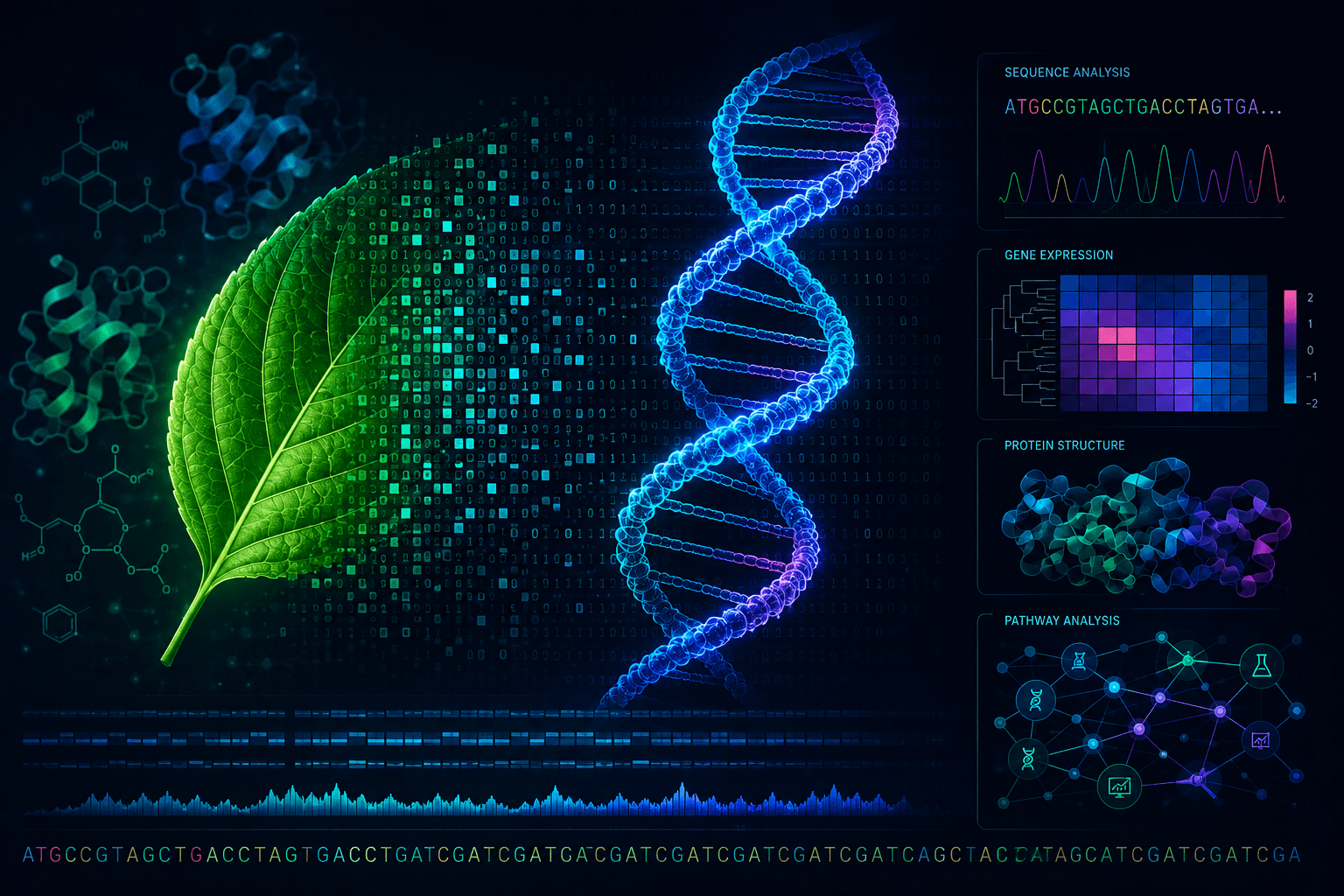
- Sequence analysis
- Expression heatmap
- Protein structure
- Pathway networks
- No prerequisitesNo programming, statistics or maths assumed. Every course starts from zero.
- Real biological dataSequences, expression matrices and variant calls — never toy datasets.
- Written, not scrapedAll 545K words are original material written for ComputingLifeSci.
- 23
- Courses
- 1.4K+
- Chapters
- 8
- Languages taught
- 54
- Animations
- 545K+
- Words written
Explore our most popular courses
View all coursesA dictionary isn't a key-value store. It's the codon table.
Most programming courses teach with bank accounts and pizza orders. Here a for loop isn't counting to ten — it's scanning a genome for a restriction site.
Start with the two languages that matter
Python and R are free in full — every chapter, forever. A free account is all it takes.
Python for Biologists
From first script to publication-ready analysis pipelines
A biology-first Python curriculum. Every concept is introduced because a biological problem needs it — dictionaries are codon tables, loops scan genomes, dataframes hold expression matrices. Covers fundamentals, pandas/NumPy, Biopython, statistics and machine learning, and interactive Streamlit and Quarto reporting.
R for Biologists
A field guide to data — tidyverse, Bioconductor and beyond
R taught as laboratory practice rather than computer science. Starts with the six data containers and base syntax, then works through the tidyverse, Bioconductor packages (Biostrings, DESeq2, edgeR, Seurat, biomaRt), statistical modelling, survival analysis and R Markdown / Shiny reporting.
The complete curriculum
Every chapter follows the same shape: the concept, the biology it solves, the code, then exercises, MCQs and interview questions.
Programming for Biology
Python for Biologists
FreeFrom first script to publication-ready analysis pipelines
R for Biologists
FreeA field guide to data — tidyverse, Bioconductor and beyond
Perl for Biologists
The original bioinformatics workhorse, taught properly
MATLAB for Biologists
Bioinformatics, imaging, signals and Simulink modelling
SAS for Biologists
Biostatistics, clinical trials and regulatory reporting
BioJava for Biologists
Java and BioJava for production bioinformatics software
Data & Databases
SQL for Biological Databases
From SELECT to schema design for genomics data
Bioinformatics Databases
Every major biological database, explained and queried
Big Data Mining for Biologists
Hadoop, Spark and data mining at genome scale
AI & Machine Learning
Machine Learning for Biologists
Zero maths assumed — to random forests, SVMs and neural nets
Artificial Intelligence for Biologists
Deep learning, LLMs, RAG and AI agents for life science
MLOps for Biologists
Take a model from notebook to reproducible production system
AI Tools for the Bioinformatics Lab
Practical AI assistants in day-to-day research work
Genomics & Omics Analysis
NGS Analysis
Complete clinical and research sequencing pipeline
Multi-Omics & Precision Medicine
Genomics, transcriptomics, proteomics, metabolomics and more
Computational Drug Discovery
Structural bioinformatics, docking, QSAR and AI-driven design
Infrastructure & Research Tools
Linux for Biologists
Command-line foundations for computational biology
Git & GitHub for Researchers
Version control, collaboration and reproducibility
Nextflow & Snakemake
Reproducible bioinformatics workflow engineering
HPC for Bioinformatics
Clusters, schedulers and parallel genomics at scale
Cloud Computing for Biologists
AWS, GCP and Azure for genomics workloads
Bioinformatics Web Tools
BLAST, alignment, structure, docking and genome browsers
Bioinformatics Desktop Tools
PyMOL, Chimera, MEGA, Cytoscape, IGV, SnapGene and more
Know where you can work
Learning the tools is half the question. The other half is who in India actually hires for them — and at what salary. This is a working directory of every employer we could verify, with their offices, pay bands, the skills and tools each one asks for, and how to apply.
Open the directory- 199
- Employers
- 30
- Exams
- 26
- Cities
Frequently asked questions
Common questions about learning bioinformatics, answered plainly.
What is ComputingLifeSci?
ComputingLifeSci is a single structured platform for learning bioinformatics and computational biology. Computer science has long had well-trodden public routes into the field — roadmaps saying what to learn and in what order, and reference material that assumes nothing. Bioinformatics has never had an equivalent, so learners assemble a curriculum from scattered papers and half-finished tutorials. ComputingLifeSci brings roadmaps, sequenced courses, interactive explainers and reference material into one place, across 23 courses and 545,000 words on Python, R, machine learning, next-generation sequencing, databases and research infrastructure.
Does ComputingLifeSci give certificates?
No. ComputingLifeSci is not a certification body and issues no certificates, diplomas or accreditation of any kind. What it provides is the material and the sequence — the understanding itself, not a document attesting to it. If you need a credential for an employer or a university, this is not the right platform, and we would rather you knew that before subscribing.
Why is ComputingLifeSci so inexpensive?
The subscription covers the time of the people who write and maintain the material, and nothing beyond that. It is priced so that a student, a postdoc on a stipend or a researcher paying out of their own pocket can afford it without having to think about it — ₹50 per month in India, or $1 per month elsewhere. Keeping it affordable matters more than what it could earn.
Can I learn bioinformatics with no programming background?
Yes. ComputingLifeSci assumes no prior programming, mathematics or statistics knowledge. Each concept is introduced because a biological problem requires it — dictionaries are taught as codon tables, loops as genome scans, dataframes as gene expression matrices — so the reason for learning a concept always arrives before the syntax.
Which programming language should a biologist learn first?
Python is the usual first choice because it has the widest bioinformatics ecosystem (Biopython, pandas, scikit-learn) and reads close to plain English. R is the better first language if your work is mainly statistics, RNA-seq differential expression or publication-quality figures, because of Bioconductor packages such as DESeq2 and edgeR. Both courses are free in full on ComputingLifeSci.
How much does ComputingLifeSci cost?
The Python and R courses are free in full, and every other course opens its first two chapters at no cost. Full access to all 23 courses costs ₹50 per month in India, or $1 per month elsewhere, and can be cancelled at any time.
What is bioinformatics?
Bioinformatics is the use of computing to store, analyse and interpret biological data — most commonly DNA, RNA and protein sequences, gene expression measurements and genetic variants. It combines biology, statistics and programming, and it is now a routine part of genomics, drug discovery and clinical diagnostics.
How long does it take to learn bioinformatics?
Most biologists can write useful analysis scripts within 4 to 6 weeks of consistent study, and reach working competence in a specialism such as RNA-seq or variant calling in 3 to 6 months. The Python course on ComputingLifeSci runs to 87 chapters, with practice exercises after each one, and a roadmap showing what to take next.
Everything, for the price of a coffee
One subscription unlocks all 23 courses, 1.4k+ chapters and every animation. New material is added weekly.